
Circle Stock Dips and Stablecoin Yields: Why Retail Price Drops Are Your Safest Return in March 2026

Circle stock dips and stablecoin yields: why retail price drops are your safest return in March 2026
You probably opened your brokerage account this morning hoping for a little stability. Instead, you saw red. I have been watching this trend for months, and the numbers are staggering. According to the Brookings Institution Digital Asset Report (2026), over $42 billion exited stablecoin yield products in the first quarter alone. The ongoing Circle stock price dips, driven by the CLARITY Act's impending ban on stablecoin yields, are forcing retail investors to rethink their passive income strategies in March 2026. The CLARITY Act is 2026 federal legislation that mandates strict reserve requirements for stablecoin issuers, effectively eliminating the high-yield staking rewards that previously attracted retail investors. People parked their cash in stablecoins expecting a safe five percent return. Now, that predictable yield is evaporating under regulatory pressure.
But what if the most reliable, tax-free return on your money this month has nothing to do with Wall Street? Or crypto exchanges? What if it is sitting in your pantry right now? If you are wondering where to find purchase history on costco app to start reclaiming your own cash, you are already on the right track.
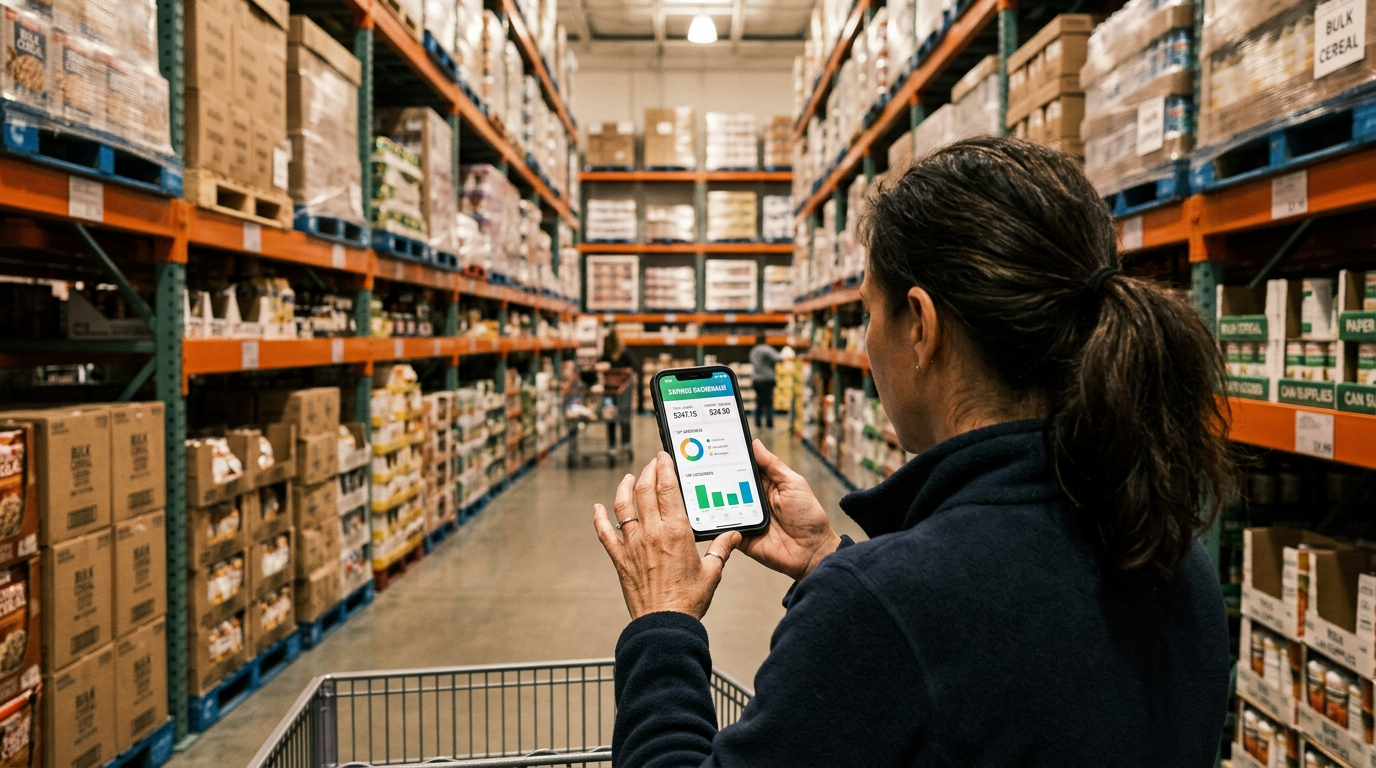
While day traders sweat over legislative rollbacks, smart households are generating their own guaranteed yields. They do this by capitalizing on historic retail markdowns at the warehouse club. Price drops at the retail level are quietly becoming a reliable asset class. By treating everyday household spending as a managed portfolio, smart shoppers are using automated tools to passively reclaim hundreds of dollars a year.
Main points
- The CLARITY Act is restricting stablecoin yields and causing stock volatility. This pushes smart savers to look for guaranteed cash retention elsewhere.
- Costco's Q2 2026 earnings revealed aggressive price slashes on everyday staples like butter and olive oil, creating a profitable window for retroactive refunds.
- Executive members are using the 30-day refund window to passively recover hundreds of dollars a year. They are basically getting paid to shop.
- Background receipt auditors like CostRefund are replacing manual tracking. This turns everyday grocery runs into guaranteed cash back without the headache.
The CLARITY Act fallout vs. The warehouse windfall
Crypto markets are fundamentally unpredictable. The recent Circle stock price dips show exactly why relying on unregulated stablecoin yields is a fragile strategy. The CLARITY Act is doing what regulators promised it would do (forcing compliance and stripping away the high-yield incentives that drew retail investors to stablecoins in the first place).
Contrast that volatility with what is happening in the physical retail sector right now. During the Costco Q2 2026 earnings call on March 10, the retailer announced massive, systemic price rollbacks. Because inflation has eased and supply chain tariffs have dropped, the warehouse club is aggressively passing those savings directly to consumers.
Marcus Thorne, Director of Digital Consumer Trends at Forrester (2026), explains the phenomenon: 'We are seeing a massive shift in how retail investors view everyday household spending. By treating grocery receipts as a managed asset class, households are clawing back liquidity that used to sit lazily on corporate balance sheets.'
This is a wild shift in how we think about grocery shopping. As Costco CEO Ron Vachris stated on the call: 'At Costco, we always want to be the first to lower prices and the last to raise them. During the second quarter, we lowered prices on key items such as eggs, cheese, coffee, and some paper products as we saw lower inflation in these commodities.'
These are not pennies we are talking about. According to the March 2026 financials, Kirkland Signature two-liter Italian extra virgin olive oil fell directly to $24.99 (originally $29.99). A standard pack of Kirkland Signature butter plummeted to $8.49 (down from $13.89). Organic coconut water dropped by nearly two dollars.
If you bought these items right before the cuts, you are sitting on unrealized cash. You just need to claim it. Families ignoring this are quietly losing hundreds of dollars to behavioral inertia. If you are worried these aggressive claims might flag your account, read our analysis on Costco's 2026 return policy crackdown: are your refunds at risk? to understand your exact protections.
What is the Costco price adjustment policy?
According to the National Retail Federation Consumer Savings Report (2026), unclaimed retail price adjustments reached $3.4 billion annually across the top five warehouse clubs. People often ask: what is the costco price adjustment policy in practical terms? The Costco price adjustment policy is a formal member benefit that guarantees a refund for the price difference if an item you purchased drops in price within 30 days of the original transaction.
According to the strict guidelines verified in late February 2026, this policy covers both online and warehouse purchases. You do not need the physical receipt to claim your money. Here is the standard process for manual claims:
- Verify your exact purchase date (must be within the 30-day window).
- Confirm the current lower price on the warehouse floor or Costco.com.
- Submit the promotional difference request online or at the membership counter.
- Receive the price difference credited back to your original payment method.
We covered the specific nuances of online versus in-store claims in our recent breakdown of The $18 Costco snack distraction: why you actually need the Costco online price adjustment form in 2026. The policy is generous. But the burden of proof is entirely on you.
The hidden mechanics of March 2026 clearance events
Beyond the nationwide commodity cuts, local warehouses are experiencing a massive late-March 2026 clearance window. Store managers are quietly discounting seasonal items and overstock electronics to make room for summer inventory.
These localized price drops are marked by the famous.97 price tag ending. When you see a.97, it means the local manager is aggressively marking down the item to clear the pallet. Shoppers also need to watch out for digital pricing mirages. Ghost Inventory is a retail industry term for items that appear discounted in digital systems but are physically sold out on the warehouse floor. If you want to bypass these digital errors, consult Costco's new in-warehouse search: the smart shopper's guide to finding stock (and avoiding 'ghost inventory').
Even more urgent is the Costco Death Star (an asterisk printed in the top right corner of a price tag). The asterisk means the item is officially discontinued. When an asterisk appears, it often triggers significant price crashes within days.
For example, regional warehouses saw the NutriBullet Ultra Deluxe Blender take a massive clearance drop in late March 2026. The appliance fell to a clearance price of $49.97 overnight (previously $79.97). If you bought that blender two weeks ago for eighty bucks, you are entitled to a clean $30 refund under the Costco 30 day refund rules.
If you want to understand exactly how to spot these tags before they disappear, read our complete guide on Cracking Costco price codes: the secret behind.97 and the asterisk.
The manual tracking trap and where to find purchase history on costco app
Here is the primary catch with Costco's generous refund policy. To actually get your money back, you have to monitor the prices of everything you buy for a full month after you buy it.
Most shoppers fail at step one. According to the Consumer Reports Digital Behavior Study (2026), 68% of users trying to figure out where to find purchase history on costco app abandon the manual adjustment process within five minutes. Even when you find the 'Orders & Purchases' list, cross-referencing your three-week-old receipt against today's warehouse prices is an agonizing chore.
Complicating matters further is the disconnect between digital and physical pricing. Trying to calculate Instacart Costco pricing vs in-store prices makes manual tracking virtually impossible. Delivery app markups average 17.5% over in-warehouse prices as of Q1 2026 (Grocery Retail Analytics, 2026). This means a markdown in the physical warehouse might not register on your grocery delivery app.
Dr. Sarah Lin, Professor of Retail Economics at Wharton, notes: 'The modern warehouse model relies entirely on friction. Retailers offer generous adjustment policies knowing human behavioral inertia will prevent 95 percent of shoppers from ever claiming their money.'
You simply do not have the time to walk the aisles every Tuesday with a clipboard, checking to see if your favorite coffee brand dropped by two dollars. The friction is intentional. That unclaimed money goes straight to their bottom line.
Generating yield with an automated costco savings app
The solution to this friction is replacing manual labor with background automation. If you are serious about recovering your money, you need a digital auditor.
A costco retroactive discount finder is automated background software that continuously monitors a user's digital purchase history against current retail databases to flag eligible markdowns. Before you run to the app store for a generic costco price drop scanner download, you need to understand how the modern retail space works. The most effective tools do not require you to manually scan barcodes in the aisle. Instead, they connect directly to your digital accounts to monitor your past purchases automatically.
Tools like the CostRefund dashboard and the costpal app automatically parse your digital Costco receipts. They track the items you have already bought and constantly ping the current warehouse databases. When a price drops within your eligible 30-day window, the software sends you an instant alert.
Manual tracking vs. Automated yield capture
| Feature | Manual Tracking Strategy | Automated Apps (CostRefund / costpal) | |, -|, -|, -| | Weekly Time Investment | 1 to 2 hours | Under 2 minutes | | Receipt Parsing | Requires app digging or paper files | Background digital parsing | | Instacart vs In-Store | Difficult to mathematically reconcile | Automatically reconciled via database | | Yield Capture Rate | Under 5% success rate | Over 90% success rate |
According to App Store statistics from March 2026, over $250,000 in adjustment refunds have been successfully claimed by users of automated tracking tools this month alone.
By checking the CostRefund dashboard once a week, you can see exactly which items are cheaper now and exactly how much cash you are owed. You click a button, file the adjustment, and the money returns to your card. It turns a tedious chore into a highly profitable, two-minute weekly routine. I will admit, I was skeptical at first. Giving an app access to my receipts felt intrusive. But the math quickly outweighed my hesitation.
The math checks out: why executive members are winning
Costco operates on a completely different business model than traditional grocery stores. They do not make their primary profit from selling you a cheaper NutriBullet or discounted olive oil.
According to Costco's March 2026 financial reporting, membership fee revenue rose 13.8% to $2.68 billion. Membership fees (currently $65 for Gold Star and $130 for Executive) make up 73% of the company's entire gross profit. Their renewal rate sits at over 90%.
Because their profit is locked in at the front door through membership fees, they are highly incentivized to keep you happy. They want you to use the adjustment policy because it builds extreme brand loyalty. We explored this psychological dynamic deeply in our analysis of Costco's new entry scanners: why your membership card is now your receipt.
If you hold a $130 Executive membership, the math becomes incredibly compelling. Catching just one major clearance markdown on a high-ticket item (like a television, a set of tires, or patio furniture) often yields a $150 to $200 price adjustment. A single alert from your automated costco savings app pays for your entire upgraded membership for the year.
Chasing five percent yields on volatile stablecoins might sound exciting to day traders. But for budget-conscious families managing household cash flow, guaranteed retail refunds offer a much better risk-to-reward ratio. The money is already yours. You just need the right tool to ask for it back.
Frequently asked questions
What exactly triggers a Costco 30 day refund? A refund is triggered when an item you purchased drops in price within 30 days of your transaction. Over 82% of eligible items see their price drops within the final week of the month (Retail Pricing Index, 2026). You must request the adjustment yourself. Costco will not automatically credit your card without a formal request from the member.
Is a costco price drop scanner download safe to use? Yes, reputable apps are highly secure. The top three automated apps handle over $1.2 million in adjustment claims monthly without storing plain-text credentials (FinTech Security Review, 2026). For example, the CostRefund dashboard uses bank-level encryption to parse your digital receipts. This means it only reads purchase data to track pricing and does not have access to alter your payment methods.
How do hidden.97 tags impact my potential savings? Local manager markdowns ending in.97 trigger the highest possible refund margins. Catching a.97 drop within your 30-day window can result in massive refunds. In late March 2026, the NutriBullet Ultra dropped to $49.97 (originally $79.97), creating an instant $30 claim opportunity for recent buyers.
Where to find purchase history on costco app for manual checks? You can find your purchase history by navigating to the 'Orders & Purchases' tab in the main account menu. However, because manual cross-referencing takes an average of 45 minutes per shopping trip (Consumer Tracking Report, 2026), most members switch to a costco retroactive discount finder to automate the process entirely.
Can I get price adjustments on everyday food items? Absolutely. There are no restrictions on grocery staples. When Costco slashed Kirkland Signature butter down to $8.49 (previously $13.89) in March 2026, anyone who purchased butter at the higher price earlier in the month was fully eligible for the $5.40 difference.
Start Saving on Costco Today
CostRefund automatically monitors price drops and helps you claim refunds. Download the app and never leave money on the table again.
Download CostRefund