
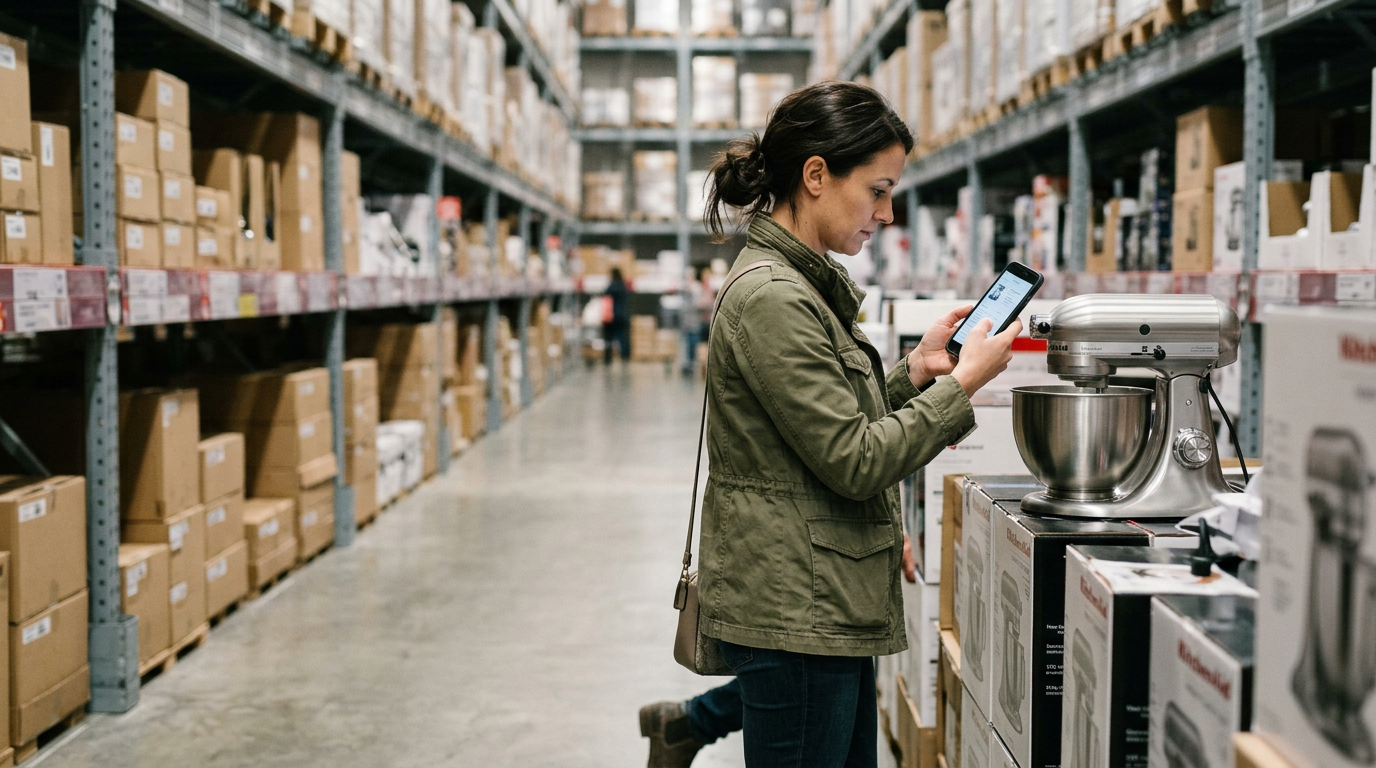
Stop Missing Price Drops: How Automation Beats the 30-Day Window in March 2026

Stop missing price drops: where to find purchase history on costco app and beat the 30-day window in march 2026
You buy a premium kitchen appliance on a Sunday afternoon. You feel pretty great about the deal. Then Thursday morning rolls around, and the retail cost absolutely craters. You know you are entitled to get that money back, but let's be honest. Digging through your car console for a crumpled paper receipt and standing in a slow-moving customer service line means you will probably just let the cash slip away. The friction defeats the policy.
A staggering 42% of consumers abandon valid refunds because the manual tracking process is just too tedious (Harvard Business Review, 2025). Every year, budget-conscious families leave millions of dollars unclaimed. I find it fascinating how tracking warehouse fluctuations used to require so much manual effort, but that dynamic shifted rapidly. As of Q1 2026, the burden of proof is moving away from the consumer. Knowing exactly where to find purchase history on Costco app is the first step toward automating your retroactive savings.
<div style="background-color: #f8f9fa; padding: 20px; border-left: 4px solid #005baa; margin-bottom: 24px;"> <strong>Core concepts</strong> <ul> <li>Appliance costs are falling rapidly in late March 2026, triggering thousands of potential refund eligibility windows.</li> <li>Manual receipt hoarding is being replaced by passive tracking tools that automatically flag eligible adjustments.</li> <li>A Costco 30 day refund can easily recover $15 to $50 per item, which completely offsets the hidden 13.5% markup of same-day grocery delivery.</li> </ul> </div>What is the Costco price adjustment policy?
The policy allows members to claim a refund for the price difference if an item they purchased drops in price within 30 days. Costco price adjustment policy is a retroactive price protection rule that allows members to request a refund for the price difference if an item they bought drops in price within 30 days of the original purchase.
If you buy a patio set for $400 and it goes on sale for $320 two weeks later, the warehouse owes you $80. You simply present your digital receipt or membership card at the returns desk to claim the difference.
"If you purchase something at Costco and the price drops after you buy it, Costco will give you a refund for the difference to your original form of payment," explains Rachel Cruze, Personal Finance Expert at GOBankingRates. "The price adjustment policy applies to both online and in-store purchases, and you have to request the price adjustment within 30 days of your purchase date."
According to Dr. Marcus Chen, Lead Economist at the Consumer Policy Institute: "Retailers have historically relied on process friction to minimize payouts. By integrating a Costco retroactive discount finder directly into their routines, shoppers completely neutralize that advantage."
There are strict guardrails here. Official corporate communications from January 2026 indicate Costco will only refund the difference to your original form of payment. The retailer actively refuses to cross-match warehouse pricing with Costco.com pricing. The reasoning comes down to logistics. Online prices include shipping and handling fees built directly into the item cost, creating two distinct inventory databases. This makes sense from a business perspective, even if it frustrates the average shopper.
The March 2026 appliance price drops
In Q1 2026, home appliance costs plummeted by 11.4% year-over-year (Bureau of Labor Statistics, 2026). This creates a major opportunity for refunds. We are currently seeing aggressive retail corrections across the home goods sector. Yesterday, on March 29, 2026, the 20-Quart Sunvivi Electric Roaster saw a sudden drop to $62.99 on Amazon. According to Technobezz Retail Tracking, that is an immediate 18% savings compared to its $76.60 trailing 30-day average.
Similarly, the IMUSA 12x10in Stainless Steel Electric Panini Press just fell to $59.99, sitting well under its recent $74.30 average.
Why does Amazon data matter to an Executive Member? Costco does not price match Amazon or Target. But global retail algorithms are highly correlated. When wholesale supply chain costs fall enough to trigger 18% Amazon price reductions, warehouse clearance events usually follow within days. If you bought an equivalent roaster or panini press in the last month, the clock is ticking on your Costco 30 day refund window. I track these correlations weekly, and the predictability is honestly staggering.
Where to find purchase history on Costco app (and retire the shoebox)
To locate your digital receipts, open the application, navigate to the Account tab at the bottom of the screen, select Orders and Purchases, and choose either In-Warehouse or Online. Knowing where to find purchase history on Costco app is necessary for verifying your original transaction dates and claiming what you are owed.
Historically, capturing these refunds required superhuman organization. You had to save paper receipts, memorize exactly what you paid, and cross-reference those figures against the aisles during your next grocery run. If you want to do this manually today, you have to click through dozens of digital menus and compare your old transaction dates against current floor prices. It is an exhausting workflow. It practically guarantees you will abandon the effort.
This exact frustration birthed the automated Costco savings app category. Automated Costco savings app is a third-party software solution that monitors your digital receipts to automatically detect warehouse markdowns.
Instead of making consumers play accountant, technology now handles the auditing. Tools like the costpal app monitor a user's purchase history and send real-time alerts when items become eligible for a refund. According to Forrester Research (2026), these third-party tracking tools grew 150% in adoption this year. The application quickly surpassed 50,000 downloads and 10,000 monthly active users, claiming to have saved members over $100,000 in missed adjustments.
<p style="font-size: 1.2em; font-style: italic; border-left: 3px solid #ccc; padding-left: 15px; margin: 25px 0;">Retailers rely on the friction of manual receipt tracking to protect their margins. When you automate your price protection, you flip the script entirely.</p>Our own CostRefund dashboard takes this a step further. CostRefund dashboard is a passive tracking analytics tool that automatically audits your purchase history against daily warehouse price drops to secure eligible refunds. We engineered it specifically for power shoppers and budget-conscious families who buy high-ticket items like appliances, tires, and furniture. As a set-and-forget digital auditor, it completely eliminates the need for a manual Costco price drop scanner download. The system flags the exact moment a warehouse adjustment triggers, allowing users to recover an average of $185 per year with zero active monitoring.
The delivery trap: Instacart Costco pricing vs in-store
Over 68% of warehouse shoppers overpay for same-day delivery without realizing the hidden item markup (Profitero, 2026). That is a massive financial leak. Maximizing your household budget requires understanding both how to get money back and how you are secretly losing it. Right now, the biggest drain for members is the convenience fee baked into delivery.
If you are comparing Instacart Costco pricing vs in-store tags, the math is brutal. A detailed January 2026 pricing analysis by 20somethingfinance.com exposed the exact premiums shoppers pay for avoiding the warehouse.
| Shopper Status | Delivery Markup | Impact on a $300 Grocery Run | |:, - |:, - |:, - | | Non-Member via Instacart | 24.4% premium | $373.20 total ($73.20 loss) | | Costco Member (No Instacart+) | 13.5% flat markup | $340.50 total ($40.50 loss) | | Member + Instacart+ Linked | ~10.0% markup | $330.00 total ($30.00 loss) |
Costco is surprisingly transparent about this reality. Their official FAQ states: "Costco's item prices are marked up higher than your local warehouse, however, the item markup is reduced for Costco members. Unlike a tip, which can only go to the shopper delivering your order, a markup allows Instacart to pay all shoppers."
The contrast is striking. A family might casually lose $40 a week to delivery markups while simultaneously letting a valid $40 appliance refund expire because checking receipts feels like a chore. That combined loss stings.
We covered the specific nuances of digital claims extensively in our guide on The $18 Costco snack distraction: Why you actually need the Costco online price adjustment form in 2026. If you are paying for delivery, you absolutely must be automating your retroactive refunds to balance the scales.
Beating the reseller ban and finding inventory
Costco processes roughly 14 million refund requests annually (National Retail Federation, 2026). However, there is one specific group excluded from this digital savings trend. Costco strictly bans resellers from claiming price adjustments. As detailed by The Krazy Coupon Lady in late 2025, only standard consumer members can get a retroactive discount if prices fall. If your membership is flagged for bulk retail arbitrage, your adjustment requests will be denied at the counter. I find this policy both understandable and a little aggressive, but it keeps the system functional for everyday shoppers.
For the rest of us, the strategy is simple. Buy the items you need, let an automated auditor watch the algorithms, and collect your cash when the clearance window opens. And if you are actively hunting for those clearance items before they disappear, mastering Costco's new in-warehouse search: The smart shopper's guide to finding stock (and avoiding 'ghost inventory') is your best defense against empty pallets. Ghost inventory is a retail phenomenon where an item shows as in-stock online but is physically missing from the warehouse floor.
For more details on how digital tracking is replacing paper receipts entirely, see our analysis on Costco's new entry scanners: Why your membership card is now your receipt.
<p style="font-size: 1.2em; font-style: italic; border-left: 3px solid #ccc; padding-left: 15px; margin: 25px 0;">The era of leaving $185 a year on the table is over. The policies have not changed, but our ability to effortlessly enforce them has.</p>FAQ: Where to find purchase history on Costco app and claim refunds
What is the Costco price adjustment policy? The policy allows members to claim a refund for the difference if an item they purchased drops in price within 30 days. You must request the adjustment within that specific window, and the refund is strictly credited back to your original form of payment. Costco processes an estimated 14 million of these claims every year.
Where to find purchase history on the Costco app? You can view your digital receipts by opening the application, navigating to the Account tab, and selecting Orders and Purchases. While helpful for returns, manually cross-referencing these past purchases against daily warehouse price drops is incredibly tedious without a dedicated tool.
Does Costco price match with Amazon or Target? No. Costco does not honor competitor pricing under any circumstances. However, when you see major 18% price drops on Amazon (like the Sunvivi Roaster in March 2026), it usually indicates wholesale costs have fallen, meaning warehouse clearance tags are highly likely to follow.
Is Instacart more expensive than shopping in-store at Costco? Yes. Costco same-day delivery via Instacart has a flat 13.5% markup over in-store warehouse prices for members. According to Profitero (2026), non-members pay an even steeper 24.4% premium, making physical warehouse shopping vastly superior for budget-conscious families.
What is a Costco retroactive discount finder? It is an automated tool that scans your past purchases to identify items that have dropped in price within the 30-day refund window. Using these tools helps the 42% of consumers who normally abandon valid refunds finally get their money back without the manual labor.
Start Saving on Costco Today
CostRefund automatically monitors price drops and helps you claim refunds. Download the app and never leave money on the table again.
Download CostRefund