Costco vs Sam's Club: Price Adjustment Compared

Quick answer: Costco does not publish a formal price adjustment policy, but members who ask a warehouse or Member Services about a price drop within roughly 30 days of purchase commonly get store credit toward the difference — approval is at the warehouse's discretion. Sam's Club also has no published formal price adjustment policy; members report similar informal luck within a short window after purchase, but neither club guarantees it in writing. If you shop at either warehouse, your best move is tracking your own receipts and watching for drops yourself, since you can't count on a published rule to back you up.
Key takeaways
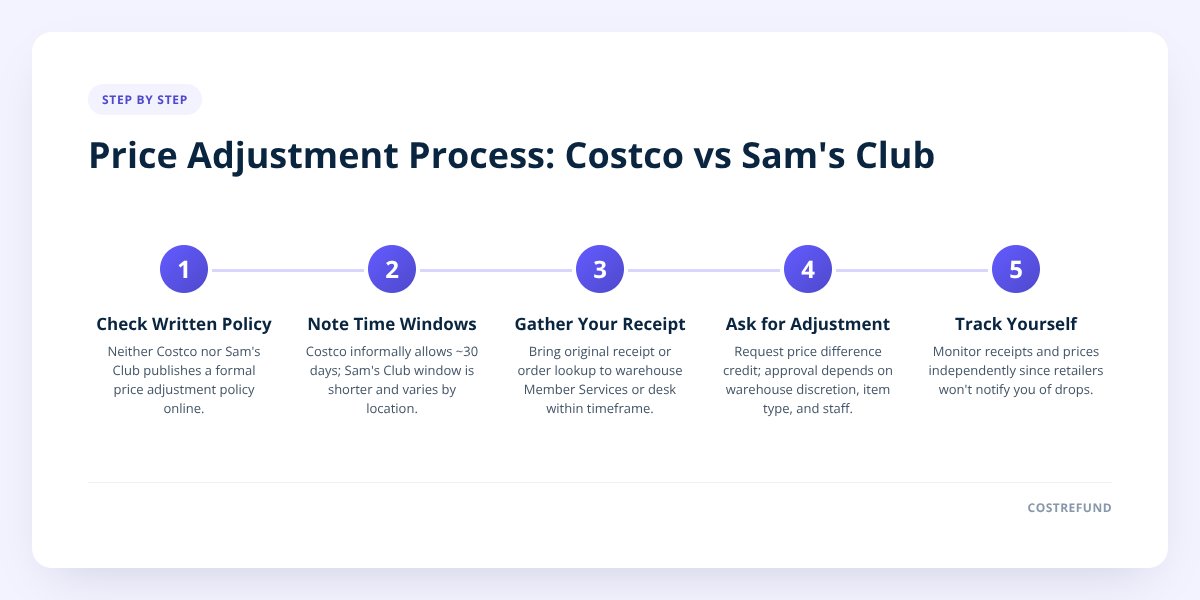
- Neither Costco nor Sam's Club publishes a formal, written price adjustment policy — both operate on informal, discretion-based practice reported by members.
- Costco's unwritten practice generally runs about 30 days from purchase; Sam's Club's informal window is reported as shorter by many members, so ask in-club to confirm.
- Both retailers' return policies are far more generous and clearly documented than their price adjustment practices, which is why some shoppers return and rebuy instead of asking for an adjustment.
- Tools like CostRefund can track your Costco receipts for 30 days and flag price drops automatically, since Costco itself won't notify you.
Does Costco Have a Price Adjustment Policy?
Not a formal one. Costco does not list a price adjustment policy on its corporate website the way it lists its return policy, and the company has never published a guaranteed adjustment window or guaranteed refund process.
What actually happens, based on consistent member reports, is this: if an item you bought drops in price within about 30 days, you can bring your receipt to a warehouse or call Member Services, and many members get the difference credited back. This is a practice, not a promise — approval depends on the specific warehouse, the item, and sometimes the employee you talk to.
That distinction matters more than it sounds. A published policy gives you something to point to. An informal practice means the answer can genuinely be "no" on one visit and "yes" on another, even for the identical item. We've laid out exactly how this works, including online purchases and in-store visits, in our full breakdown of the Costco price adjustment policy.
A few things that shape whether you're likely to get an adjustment at Costco:
- Bring the original receipt or have your order lookup ready if it was a Costco.com purchase.
- Ask within the informal ~30-day window most members report — the further out, the less likely.
- Understand that clearance, one-time-only, and manager's special items are typically excluded from adjustments.
- Know that tires and Costco Auto Program purchases sometimes follow different rules — we cover that separately in how Costco tire price adjustments work.
- Expect in-store and online purchases to be handled a little differently — see our guide on Costco price adjustment in-store.
Does Sam's Club Have a Price Adjustment Policy?
No — like Costco, Sam's Club does not publish a formal price adjustment policy on its corporate site. Member reports describe a similarly informal practice: bring your receipt to the Member Service desk within a short window after purchase and ask whether they'll credit the difference.
The reported window at Sam's Club tends to run shorter than what Costco members describe, though neither club states an exact number of days anywhere official. Because nothing is written down, the only reliable way to know what you'll get is to ask your local club directly and treat whatever they tell you as club-specific, not company-wide.
This is the core problem with comparing the two: you're not really comparing two policies. You're comparing two sets of member anecdotes about unwritten practices that can vary by location, by item, and by who's working the desk that day.
Costco vs Sam's Club: Side-by-Side Comparison
| Costco | Sam's Club | |
|---|---|---|
| Written policy | None published — informal practice only | None published — informal practice only |
| Reported adjustment window | Commonly ~30 days per member reports | Often reported shorter; varies by club |
| Where to ask | Warehouse Member Services or phone | Member Service desk |
| Online purchase adjustments | Some members report success via Costco.com order history | Less consistently reported |
| Common exclusions | Clearance, manager's specials, one-time deals | Clearance and rollback items typically excluded |
| Best way to track eligibility | Save receipts, monitor prices yourself (or use an app) | Save receipts, monitor prices yourself |
Our take: if you're a member of both, don't expect either one to owe you anything automatically — treat any adjustment as a courtesy, not an entitlement. Costco's practice is the more consistently reported of the two, with a longer informal window and more member success stories around the 30-day mark, which is exactly why tracking tools built around that window (like CostRefund) exist for Costco specifically. Sam's Club shoppers should ask their local club directly before assuming any timeframe, since the reported window is shorter and less consistent club to club.
Don't skip this: because neither retailer puts a price adjustment window in writing, the number you hear from one employee isn't a guarantee for your next visit. Always confirm with your specific warehouse or club before counting on a refund.
Why Returns Are Easier to Get Than Adjustments at Both Clubs
Both Costco and Sam's Club document their return policies far more clearly than their price adjustment practices, and that gap explains a lot of shopper behavior. Costco's published return policy famously allows returns on most items with no time limit, with specific exceptions for electronics, mattresses, and a few other categories that do carry return windows.
That's a real, written policy you can rely on — which is why some Costco shoppers, when an adjustment gets denied, simply return the item and rebuy it at the new lower price instead. It's more hassle, but it works within a documented rule rather than an unwritten one.
A few return-policy specifics worth knowing if you're weighing this option:
- Electronics generally have a defined return window (commonly 90 days) rather than Costco's open-ended standard — see our notes on Costco's TV return policy for specifics.
- Mattresses are returnable but often have their own handling process given size and delivery logistics.
- Furniture, appliances, and jewelry are generally returnable under the standard policy but may involve freight pickup or in-store inspection.
- Alcohol return rules vary by state law, since some states restrict alcohol returns regardless of retailer policy.
Sam's Club similarly documents its returns policy with more specificity than its price adjustment practice, though exact terms and time limits should be confirmed with your local club since return rules can vary by state and by category.
The lesson: if an adjustment gets refused, check whether a return-and-rebuy is realistic before giving up. It's not always convenient — bulky furniture or perishable groceries make it impractical — but it's the more dependable lever of the two because it's backed by an actual written policy.
How Do You Actually Track a Price Drop After You've Already Paid?
You track it yourself, because neither Costco nor Sam's Club sends any kind of alert when something you bought goes on sale. That's the single biggest gap in both systems — the adjustment might exist informally, but nobody's watching your purchase history for you.
For Costco shoppers specifically, this is the exact gap CostRefund fills. You scan your receipt, and CostRefund tracks that purchase against Costco's price movements for the reported 30-day window, sending an alert if it looks like something you bought has dropped. CostRefund flags the potential opportunity — Costco still makes the final call on whether to approve any adjustment.
That distinction is worth repeating because it's easy to blur: an alert means "this might be worth asking about," not "your refund is approved." The actual outcome always depends on the warehouse.
If you'd rather do this manually, here's the honest version of what it takes:
- Save every Costco receipt somewhere searchable, physical or digital, for at least 30 days.
- Revisit Costco.com or your local warehouse's shelf pricing periodically for items you bought recently.
- Note the date of purchase and count forward, since the informal window is time-sensitive.
- Bring the receipt in and ask — politely and clearly — whether the item is eligible for a price adjustment.
- If declined, ask about the return-and-rebuy option instead, especially for higher-ticket items like TVs, laptops, or appliances.
Doing this by hand for every purchase is realistic for one or two big-ticket items. It gets tedious fast if you shop at Costco regularly, which is the whole reason automated tracking exists — we go deeper on what a good system looks like in our guide to the best Costco price trackers.
What Should You Do Differently for Sam's Club Purchases?
Ask in person, sooner rather than later, since there's no app or published rule to lean on. Because Sam's Club's adjustment practice is less consistently documented across member reports than Costco's, your best strategy is proactive: check prices on items you recently bought every week or two, rather than waiting for a monthly review.
If you shop at both clubs, it's worth being honest with yourself about where you actually spend more. Most warehouse shoppers lean heavily toward one club for bulk groceries and household goods and only occasionally visit the other — put your tracking energy where your dollars go.
For Costco purchases specifically, that's where a dedicated tracker earns its keep. CostRefund monitors your scanned receipts against Costco's pricing for 30 days and alerts you the moment something looks like it dropped, so you're not manually rechecking prices on a dozen items every week.
Ready to stop guessing whether you're owed money on a Costco purchase? Scan your last receipt into CostRefund and let it watch for price drops for you — get started at costrefund.com.
Checklist: Getting a Price Adjustment at Costco or Sam's Club
- Save your original receipt or pull up your Costco.com or SamsClub.com order history.
- Check the current price on the item within roughly 30 days of your purchase date.
- Confirm the item isn't clearance, a manager's special, or a one-time-only deal.
- Visit Member Services or call ahead to ask about eligibility before making a special trip.
- Bring your membership card along with the receipt.
- Ask specifically for a "price adjustment" rather than a general complaint about pricing.
- If declined, ask whether a return-and-rebuy at the lower price is possible instead.
- Set a reminder to recheck prices on big-ticket purchases like electronics or tires within the window.
Related articles
Blog by Segeo — new article every day.
Keep reading
- Costco TV Return Policy: Windows and Refund TipsSeptember 28, 20268 min read
- Costco Price Adjustment Etiquette: What's Fair to AskSeptember 6, 20267 min read
- Costco Curbside Pickup Price Adjustment Rules ExplainedSeptember 1, 20267 min read
- BJ's Wholesale vs. Costco: Price Adjustment PoliciesAugust 20, 20268 min read
- How Costco Coupon Books Set Up Price Adjustment RefundsAugust 10, 20268 min read
- 5 Signs You Just Missed Out on a Costco Price AdjustmentAugust 8, 20267 min read
Start Saving on Costco Today
CostRefund automatically monitors price drops and helps you claim refunds. Create your free account and never leave money on the table again.
Start Saving